The Matching-Set Myth: Why Coordinated Accessories Need Not Be Identical
Coordinated accessories need not match exactly. Learn how repeating color, texture, or shape creates a clear connection while letting each piece keep its character.
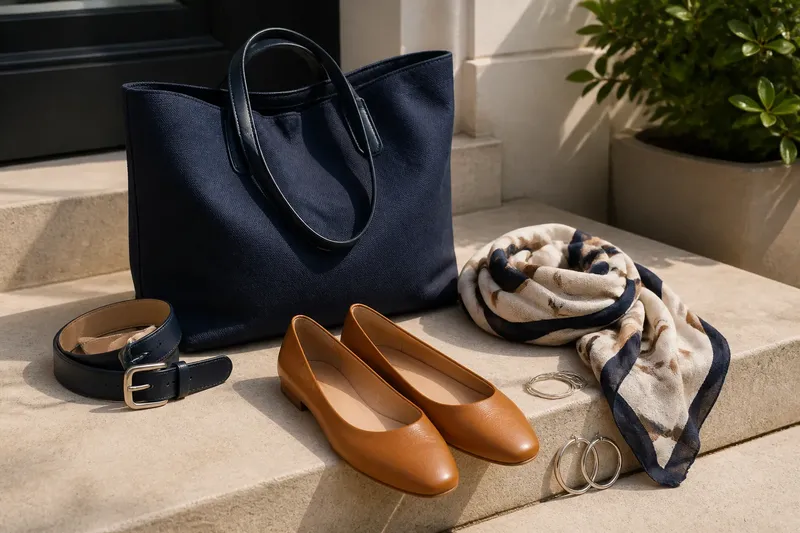
At the door, a navy canvas tote and a smooth navy belt already look related, though their surfaces disagree. Coordinated accessories do not need identical finishes, colors, or materials. Repeating one visible feature gives them a connection without making the outfit look like it arrived in a box.
Coordinated accessories need one clear visual echo
Think of coordination as an echo, not a uniform. The repeated feature might be color, texture, shape, or a detail such as warm metal. A clear echo gives the eye somewhere to land; repeating every feature can make separate objects look interchangeable.
Color is the easiest link to spot, but exact shades are unnecessary. A forest-green bag and a softer green scarf can read as related, especially when the rest of the outfit is quiet. If their colors are close but not identical, distinct surfaces help the difference look intentional.
Texture can do the work instead. A woven belt might relate to a basket-weave bag, even if their colors differ. A pebbled leather wallet and pebbled leather shoes can share a finish while differing in shape and tone. The texture needs to be visible; a resemblance hidden under a coat contributes little.
Shape is subtler. Rounded sunglasses and a curved pendant share a soft outline. A rectangular watch and square buckle repeat a sharper one. There is no need to make every accessory geometrically obedient. One clear echo is generally enough.
Let materials and finishes remain distinct
Materials reflect light differently. A glossy patent shoe and a matte handbag can appear far apart in daylight, despite having similar colors. Rather than forcing a perfect match, choose a feature that survives the difference: both pieces might be dark, have a fine grain, or carry a visible metal accent.
Metal finishes offer an easy comparison. A brass zipper on a bag can relate to warm gold-tone earrings without being the same shade. The connection is clearer when both finishes are visible, rather than reduced to a tiny fleck. Silver hardware and a silver watch can link pieces without requiring silver jewelry everywhere.
Canvas, raffia, suede, and brushed metal have different moods from patent leather, satin, or polished steel. A mix can feel coherent if the accessories share another point of contact. A straw hat and straw-colored bag, for instance, can connect through tone while their textures do separate work.
Use contrast to make the repeated feature visible
Contrast does not cancel coordination. It can make the repeated feature easier to see. A smooth black belt beside a textured black bag keeps the color link but breaks up one uninterrupted block of finish. A bright scarf can pick up a small color in a patterned tote without repeating the entire print.
Scale matters, too. If both a bag and earrings are oversized, their shared shape may compete for attention. Let one carry the stronger version of the idea and keep the other quieter. The link remains, with room for the eye to rest.
Say you have a burgundy crossbody bag, cream sneakers, and a patterned scarf with a thin burgundy line. Wear the scarf with the bag and leave the shoes cream. The bag and scarf share a visible color; the pale shoes create a break, so there is no need to seek out burgundy laces or a matching belt.
Choose a coordinating feature that suits the outfit
Before adding accessories, notice what the clothes already repeat. When an outfit has several colors, linking accessories by shape or finish may keep it from feeling busier. With simple clothes, a repeated color can make accessories feel considered without adding another pattern.
- Patterned outfit: Check which quiet color appears in the print. If one is visible, repeat it in a small accessory; if none suits the available pieces, use a simple shape or finish instead.
- Mostly neutral outfit: Check whether two accessories have a visible texture in common, such as woven leather and canvas. If they do, let that texture connect them; if not, try a shared color or outline.
- Mixed metals: Check whether one finish appears clearly on two pieces. If it does, let the other metal remain a separate accent; if it does not, remove or change one piece rather than adding metal everywhere.
- Bold accessory: Check whether another piece competes in size or visual weight. If it does, choose a smaller echo elsewhere; if it does not, keep the second piece as it is.
- Casual outfit: Check whether materials differ but share a tone or outline. If they do, keep both; if they do not, change one accessory or leave the difference unlinked.
- Several repeated details: Check whether every accessory repeats the same feature. If they do, remove one echo or vary its material; if only two pieces connect, leave the rest alone.
These are decision points, not dress codes. If the accessories already feel balanced in the mirror, another matching item may solve a problem that does not exist.
Which accessories should coordinate?
Do shoes and bags have to match?
No. They can relate through color family, material, or formality instead. A polished leather bag and suede shoes can sit comfortably together when their tones or overall mood connect.
Can different shades of the same color work?
Yes. Nearby shades can look more relaxed than an exact match, especially when one piece is matte and the other has a slight sheen. If the shades seem to clash, make their difference clearer with contrast elsewhere.
How many accessories should share a feature?
Two clear repetitions usually establish a link. A third can work when the pieces are small or the feature is subtle, but echoing the same detail across every accessory can make the outfit look assembled as a set.
What if the accessories have no obvious connection?
They may still work if their scale and formality suit the clothes. If they seem unrelated, change or remove one small piece rather than replacing everything. Coordination is a visual relationship, not a purchasing requirement.
A worked outfit shows how little matching is needed
Imagine you are choosing accessories for a simple outfit and start with a navy canvas tote, a smooth navy belt, tan leather flats, and silver hoop earrings. The tote and belt already share navy, while their finishes differ. The flats and earrings have no obvious link.
First, leave the tote and belt together: their color is visible and their textures remain distinct. Next, check the flats against the outfit; if their tan tone sits comfortably with the clothes, keep them rather than searching for navy shoes. Finally, look at the silver hoops beside the tote and belt. If the silver has no other visible echo and feels distracting, switch to a smaller pair; if it sits quietly with the outfit, leave it alone. The result is two connected navy accessories, one contrasting shoe choice, and no requirement that every item match.
Keep the difference that gives the outfit character
The matching-set myth treats sameness as proof of intention. In practice, a shared color, texture, shape, or finish can connect coordinated accessories while their differences keep them distinct. Pick the feature that is already visible, and let the other details vary. A useful final check is to step back from the mirror: if the connection is easy to see without every piece repeating it, the outfit has enough.