The Dressing Table Before the Vanity Mirror
The dressing table began as a household surface for clothes and personal objects. See how its practical uses, storage, and mirrors shaped its familiar form.
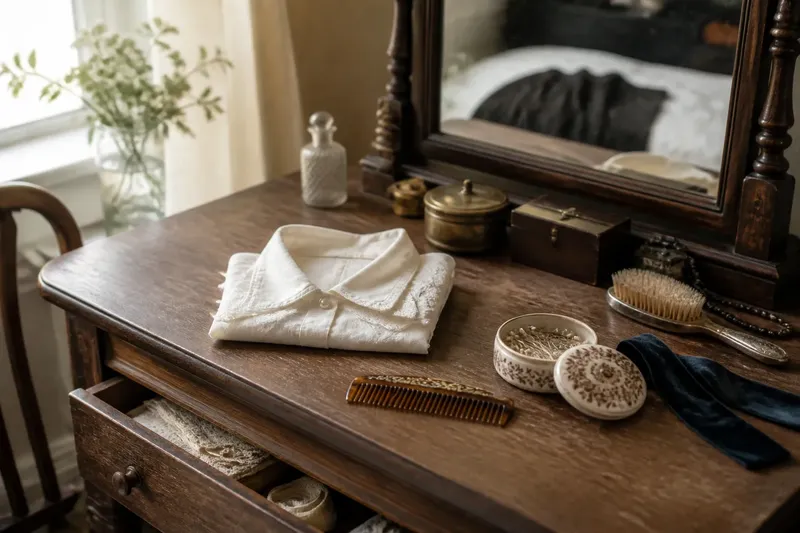
A comb rests beside a folded collar on a bedroom table. A small box of pins sits within reach. The dressing table before the vanity mirror is easiest to understand through such ordinary use: a surface put to work for clothes and personal objects, not a design with one documented starting point.
Without reliable evidence for a single origin or a neat timeline, it is better to describe the furniture through its functions than to claim exactly when its name or form emerged. A table, chest, or cabinet could support dressing if it offered a convenient surface and a place for small belongings.
The dressing table before the vanity mirror was defined by use
A dressing table did not need the familiar combination of tabletop, drawers, and raised mirror to be useful. A plain table could hold garments and personal effects. A chest or cabinet could do the same if its top was accessible and its storage suited the household.
The activity mattered more than a prescribed silhouette. Someone might prepare clothing, gather accessories, and set aside the objects used for dressing at a surface that served other purposes at different times. Calling that piece a dressing table describes its role in a routine, not necessarily a distinct historical type.
It is tempting to turn that practical distinction into a sequence of design milestones. Without specific evidence, though, claims about when the term took hold or which furniture forms came first should remain open questions. The useful point is narrower: a surface becomes part of dressing when people repeatedly use it for that task.
Personal objects made a dedicated surface useful
Small objects are easy to scatter. A brush, comb, jewelry box, ribbon, or sewing accessory can end up wherever it was last set down. Keeping such items together makes a familiar surface useful even when nobody is actively changing clothes.
Storage can help. A drawer keeps small belongings out of the way, while the top remains available for items being handled. What goes inside depends on the household; there is no universal inventory that defines the furniture.
Imagine a household with a small table beside the bedroom wall, a comb and lidded box on top, and folded cuffs nearby. The household begins putting the box and comb in the drawer each evening, then uses the cleared surface to prepare clothing in the morning. The observable result is a repeated dressing routine centered on one piece, not proof of a particular historical origin.
Mirrors made the dressing task easier to recognize
A mirror lets someone handle an item and check its appearance without moving to another part of the room. Placed on or near a dressing surface, it adds a practical task to the furniture’s existing uses.
A raised mirror can also make the purpose of a table more apparent. But a mirror is not a requirement: a bare surface may still serve dressing, while a mirror elsewhere in the room may be used alongside it. The familiar arrangement of surface, storage, and mirror combines separate conveniences rather than demonstrating a single, documented moment of invention.
The mirror did not make storage or the tabletop irrelevant. It joined them. A surface could still hold clothes and personal objects while the mirror supported a quick check of appearance.
Room arrangements shaped where the table could serve
A dedicated piece takes space. In a room with room for it, a household might keep a separate dressing surface. In a crowded room, a chest or shared table could perform the same job. The furniture’s role depended on the household’s available space and routines.
Access mattered too. One person might keep familiar belongings in a drawer; a shared table might collect several people’s objects. The latter can be less orderly than a furniture catalog suggests. Daily life is not obliged to arrange itself for a photograph.
A dressing surface could also mark a small area of personal control within a shared home. Its value lay in having a place to prepare and return belongings, not simply in its appearance.
When does a table count as a dressing table?
Does a dressing table need a mirror?
No. A mirror is a recognizable feature, but the surface can serve dressing without one. Its use for preparing clothing and keeping personal objects close is the more important distinction.
Why do dressing tables have drawers?
Drawers keep small belongings together and leave the top available for current tasks. Their contents vary by household, so they are practical storage rather than evidence of one universal routine.
How is a dressing table different from a desk?
The distinction is mainly the task organized around the surface. A desk supports writing or work; a dressing table supports preparing clothing and handling personal belongings, though one piece may serve both purposes.
Was the dressing table always in the bedroom?
No single location is necessary to its function. A bedroom may be a convenient place for dressing and personal objects, but a household can use another surface wherever those activities take place.
Its familiar shape does not require a single origin story
Surface, storage, and mirror answer different needs. A tabletop offers room to handle things, a drawer gathers smaller objects, and a mirror makes checking appearance convenient. Their combination can look inevitable once familiar, but each part is useful on its own.
Without dates or specific sources, it would be careless to claim when the name settled or how one furniture form developed into another. The dressing table before the vanity mirror is best described through a practical distinction: a household surface gained meaning through repeated use for dressing and personal objects.
When looking at an old table, notice its top, storage, and location before assigning it a label. Those details can suggest how it might have served a household, while leaving open what cannot be established from appearance alone.